Read summarized version with
Loading content...
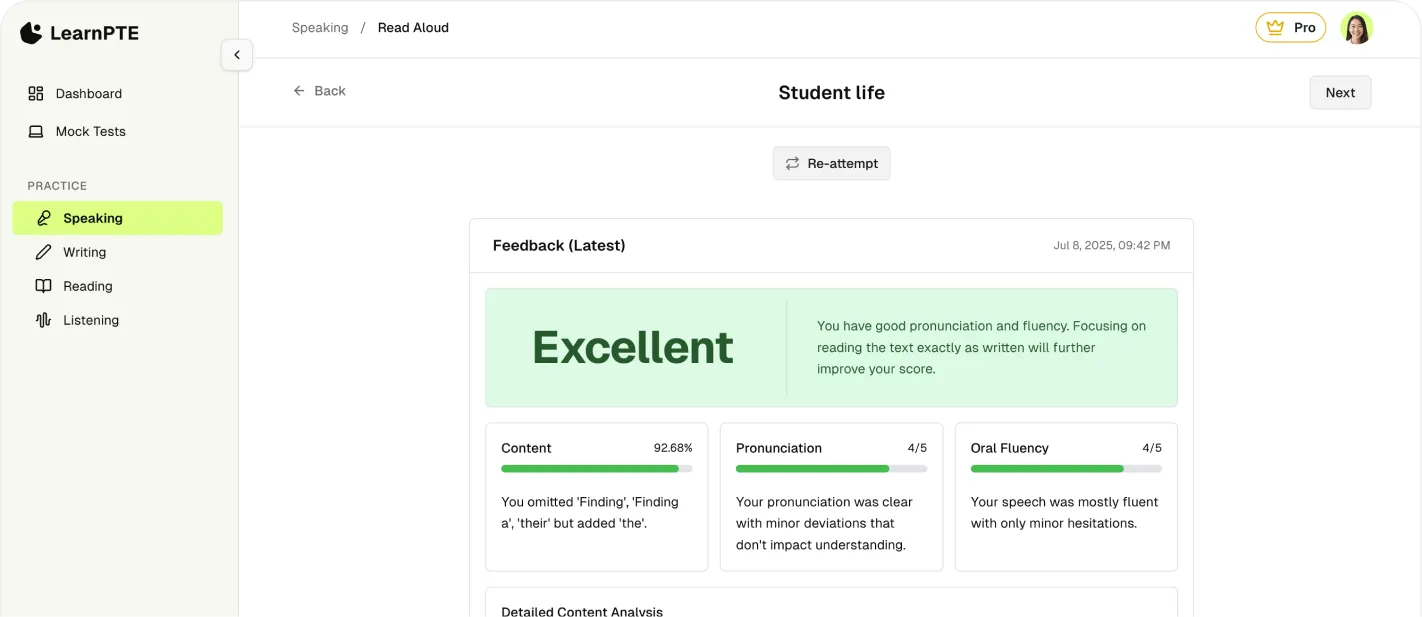
Practice for your PTE test with the most comprehensive and easy to use AI platform.
Discover the exact scoring mechanics, memory-training techniques, and time management hacks to ace the most critical task in PTE Academic.
Comprehensive guide with sample prompts and responses covering strategies and templates for preparing for PTE's Write Essay task.

Comprehensive guide with sample lectures and responses covering strategies and templates for preparing for PTE's Retell Lecture task.
If you've taken the PTE recently, you might have felt a sudden "wall" hitting you about 45 minutes into the test. In 2026, we're seeing a significant trend: students who are brilliant at Reading in practice are seeing their scores dip in the real exam.
The reason? Cognitive Fatigue.
Research from the Proceedings of the National Academy of Sciences reveals a startling truth: for every hour later in the day a test is taken, performance decreases by 0.9% of a standard deviation. But here's the kicker—by the time you reach the PTE Reading section, you've already been mentally engaged for over an hour in Speaking and Writing tasks. Your brain isn't just tired; it's running on fumes.
Since the Speaking and Writing section was extended in late 2025 (to include the 'Summarize Group Discussion' and 'Respond to a Situation' tasks), the Reading module has effectively moved further back in the test.
By the time you reach 'Fill in the Blanks,' your brain has already processed nearly an hour of intense, integrated listening and speaking. This "Stamina Gap" is why paragraphs that looked easy yesterday suddenly feel like impossible puzzles on test day.
Cognitive fatigue is defined as a condition resulting from sustained cognitive engagement that taxes your mental resources. Unlike physical tiredness, this is a depletion of your brain's ability to:
The good news? A 20-30 minute break can improve test performance by 1.7% of a standard deviation. Unfortunately, PTE doesn't offer breaks during the exam—which is why training your brain's endurance before test day is non-negotiable.
In 2026, "winging it" with your time isn't an option. The Reading section is a 29-30 minute sprint across five task types, with approximately 15-20 questions total. To survive—and thrive—you need a strict time budget based on scoring weightage.
Not all Reading tasks are created equal. The biggest mistake students make is treating every question with the same urgency. Here's the truth: Reading & Writing: Fill in the Blanks carries maximum Reading weightage, yet many students rush through it to "save time" for lower-scoring tasks.
| Task Type | Time | Scoring Impact | Strategy |
|---|---|---|---|
| Reading & Writing: Fill in the Blanks | 2-2.5 mins | HIGHEST ⭐⭐⭐⭐⭐ | Your priority. Never rush these. |
| Re-order Paragraphs | 2 mins | HIGH ⭐⭐⭐⭐ | Use notepad for logical pairs. |
| Reading: Fill in the Blanks (Drag & Drop) | 1.5-2 mins | MEDIUM ⭐⭐⭐ | Focus on collocations and grammar. |
| Multiple Choice (Multiple Answers) | 1-1.5 mins | MEDIUM-LOW ⭐⭐ | Conservative selection beats risky guessing. |
| Multiple Choice (Single Answer) | 1 min | LOWEST ⭐ | Fast decision-making. Don't overthink. |
Your success in the Reading section isn't determined by how fast you read, but by how well you conserve your mental energy for the high-scoring blanks.
— LearnPTE
Since Fill in the Blanks tasks carry maximum weightage, let's dive deep into the strategies that separate 65+ scorers from 79+ scorers.
1. Reading & Writing: Fill in the Blanks (Dropdown)
2. Reading: Fill in the Blanks (Drag & Drop)
Words in English often form natural partnerships called collocations. Recognizing these patterns is your shortcut to accuracy:
Common Collocations to Master:
When you see a blank, immediately ask:
1.What word type fits? (noun, verb, adjective, adverb)
2.What does the grammar demand?
3.Does the context require a positive or negative word?
Start by eliminating obviously wrong answers:
Often, you can eliminate 2-3 options immediately, making your choice easier even if you're unsure about the perfect answer.
To overcome cognitive fatigue, you have to train your brain to stay focused on long-form English content for at least 90 minutes without a break. Think of it as mental marathon training.
Avoid 'Micro-Reading': Scrolling through social media or short news snippets doesn't help. These train your brain for brief attention bursts, not sustained focus. The PTE Reading passages can be up to 300 words—dense academic English that requires deep concentration.
The 90-Minute Stamina Rule: If you're taking a 4-5 hour test, you can't expect to focus effectively without building test-taking stamina. Start with 30 minutes of unbroken reading, then gradually increase to 90 minutes.
Week 1-2: Foundation (30 minutes daily)
Week 3-4: Expansion (45 minutes daily)
Week 5-8: Test Simulation (60-90 minutes)

Re-order Paragraphs tests your ability to understand how ideas in a text are connected through coherence and cohesion. With 4-5 sentences presented in random order, you need to arrange them logically—and every correct adjacent pair earns you marks.
While it seems counter-intuitive, your erasable notepad is your best friend in Re-order Paragraphs.
Instead of moving blocks around on the screen repeatedly (which is visually draining and time-consuming), identify pairs on your paper. If you find that sentence B must follow sentence A, just write A+B on your pad. Finding these "logical pairs" is much easier on the eyes than trying to hold the whole paragraph in your head.
Step 1: Find the Independent Topic Sentence
Step 2: Look for Cohesive Devices
These are your roadmap to logical connections:
| Cohesive Device | What to Look For | Example |
|---|---|---|
| Pronouns | "it," "they," "this," "these," "such" | "These effects" must follow a sentence about effects |
| Articles | "a/an" (first mention) → "the" (subsequent mention) | "a study" → later "the study" |
| Time markers | "initially," "then," "subsequently," "finally" | Shows sequence |
| Linking words | "furthermore," "however," "moreover," "consequently" | Shows relationship between ideas |
| Demonstratives | "this approach," "such methods" | Must refer back to something |
Step 3: Build Logical Pairs on Your Notepad
Write down confirmed connections:
Multiple Choice questions in PTE Reading come in two forms, and understanding their scoring mechanics is crucial.
This is where students lose easy points. Here's why:
Scoring:
The Trap: You see three options that seem plausible, select all three, and think "at least I'll get partial credit." Wrong. If only two are correct, your score is 2 - 1 = 1. If you had selected only the two correct ones, your score would be 2.
The Strategy:
Scoring:
The Strategy:
What happens if you have 5 minutes left and 7 questions to go? This is where many students lose their 79+ score. Panic sets in, mistakes multiply, and your carefully maintained score crumbles.
When time pressure hits, use this priority ranking:
Priority 1: Reading & Writing Fill in the Blanks (2 minutes per question)
Priority 2: Re-order Paragraphs (1.5 minutes under pressure)
Priority 3: Reading Fill in the Blanks (Drag & Drop) (1 minute under pressure)
Priority 4: Multiple Choice (both types) (30 seconds under pressure)
DON'T try to read every word: When time is short, focus on the sentence containing the blank plus one sentence before/after for context. That's enough.
DON'T get stuck on Multiple Choice: These questions carry very few points. If you're short on time, pick a reasonable answer in 20 seconds and move to the Fill in the Blanks.
DON'T forget negative marking: In Multiple Choice (Multiple Answer), if you aren't 100% sure about a second option, select only one. A +1 and a -1 equals zero. One safe point beats risky guessing.
DON'T leave blanks empty: Unlike the Multiple Answer tasks, Fill in the Blanks (both types) do not have negative marking. An educated guess based on grammar is better than leaving it blank. You have a 20-25% chance even with a random guess.
DON'T sacrifice accuracy for speed in high-value tasks: If you have to choose between completing two low-value MCQs or one high-value Fill in the Blanks properly, choose the latter.
If you feel panic rising:
This 5-second reset can prevent a cascade of errors caused by panic-driven rushing.
At LearnPTE, we've designed our practice Reading assessments to mirror the increased length and complexity reported by students this year. We don't just give you a score; we show you where your time went.
Give our 2026 Time-Pressured Mock Reading Test a try here. Master the clock, master the test.
You've prepared for weeks. Now it's time to execute. Here's your test day game plan for the Reading section.
Energy Conservation During Earlier Sections:
When the Reading section begins:
The Flag & Return Method:
The Self-Talk Strategy:
Even well-prepared students make these errors. Avoid them to protect your score.
What students do: Try to find the "perfect" sequence by testing multiple combinations Why it fails: Wastes 4-5 minutes on a question with limited score impact Fix: Use the logical pairs method—if A+B and C+D are certain, try both A+B+C+D and C+D+A+B quickly
What students do: Select words based only on meaning, ignoring grammar Why it fails: "Quick" (adjective) and "quickly" (adverb) might both make semantic sense, but only one fits grammatically Fix: Always identify the required word type before looking at meaning
What students do: Read 300 words, then read all 4-5 options, then re-read parts of the passage Why it fails: Time sink with minimal score benefit Fix: Skim for main idea, eliminate obviously wrong answers, make a decision in 1 minute
What students do: Think "more selections = more points possible" Why it fails: Negative marking means risky selections reduce your score Fix: Select only answers you're confident about. Two confident selections beat three risky ones.
What students do: Practice Reading section fresh, at the start of study sessions Why it fails: Doesn't simulate real test conditions where you're already 60+ minutes into the exam Fix: Always do 30-40 minutes of Speaking/Writing practice BEFORE your Reading practice
When cognitive fatigue hits during the Reading section, your mental approach matters.
Instead of: "I'm so tired, I can't think clearly" Think: "Everyone feels tired at this point. This is when my preparation pays off."
The Reading section will test your focus when you're already mentally tired. That's by design. Accept that:
Reducing anxiety about fatigue actually reduces the cognitive load it creates.
Research & Study:
Change & Development:
Cause & Effect:
Agreement & Support:
Criticism & Opposition:
Daily Reading (30 minutes):
Why these sources?
The Reading section is a test of focus, strategy, and mental endurance. The students who succeed in 2026 are those who manage their cognitive fatigue as skillfully as they manage their grammar.
— LearnPTE Team
🎯 Cognitive fatigue is your biggest enemy—build stamina through sustained reading practice (90+ minutes)
🎯 Not all questions are equal—prioritize Reading & Writing Fill in the Blanks (highest weightage)
🎯 Master collocations—they're your shortcut to accuracy in Fill in the Blanks
🎯 Use your notepad strategically—logical pairs method for Re-order Paragraphs
🎯 Beware negative marking—conservative selection in Multiple Choice, Multiple Answers
🎯 Practice under fatigue—always do Speaking/Writing before Reading practice
🎯 Have an emergency protocol—triage system when time runs short
🎯 Manage mental fatigue—accept it as part of the challenge, not a barrier to success
Start your preparation with LearnPTE's AI-powered practice platform. Our 2026-updated materials simulate real test conditions, track your time leaks, and build the exact skills you need to overcome cognitive fatigue and achieve your target score.